
Degenerative Disc Disease: What It Actually Means — and What You Can Do About It Without Surgery
If you’ve been told you have “degenerative disc disease,” you may have walked out of that appointment feeling like your spine is falling apart and surgery is inevitable. Neither of those things is necessarily true.
“Degenerative disc disease” — often abbreviated DDD — is one of medicine’s more unfortunate phrases. It sounds catastrophic. In reality, it describes a spectrum of age-related changes to the intervertebral discs that are extremely common, often asymptomatic, and in many patients quite manageable without surgery.
But for those in whom degeneration is causing real pain? There are now regenerative medicine options — including intradiscal PRP and bone marrow concentrate — that target the actual biology of disc breakdown rather than simply masking symptoms or removing the disc entirely.
What Is Degenerative Disc Disease?
Between each pair of vertebrae in your spine sits an intervertebral disc — a fibrous ring (the annulus fibrosus) surrounding a gel-like center (the nucleus pulposus). The disc acts as a shock absorber, distributes load across the vertebral segment, and allows the spine to move.
Over time — starting as early as your 20s — the nucleus loses hydration. The disc gradually flattens, loses height, and develops small tears in the annulus. The disc also has a very poor intrinsic blood supply, which means it heals slowly and incompletely on its own. The result: chronic inflammation, altered spinal biomechanics, and low back pain.
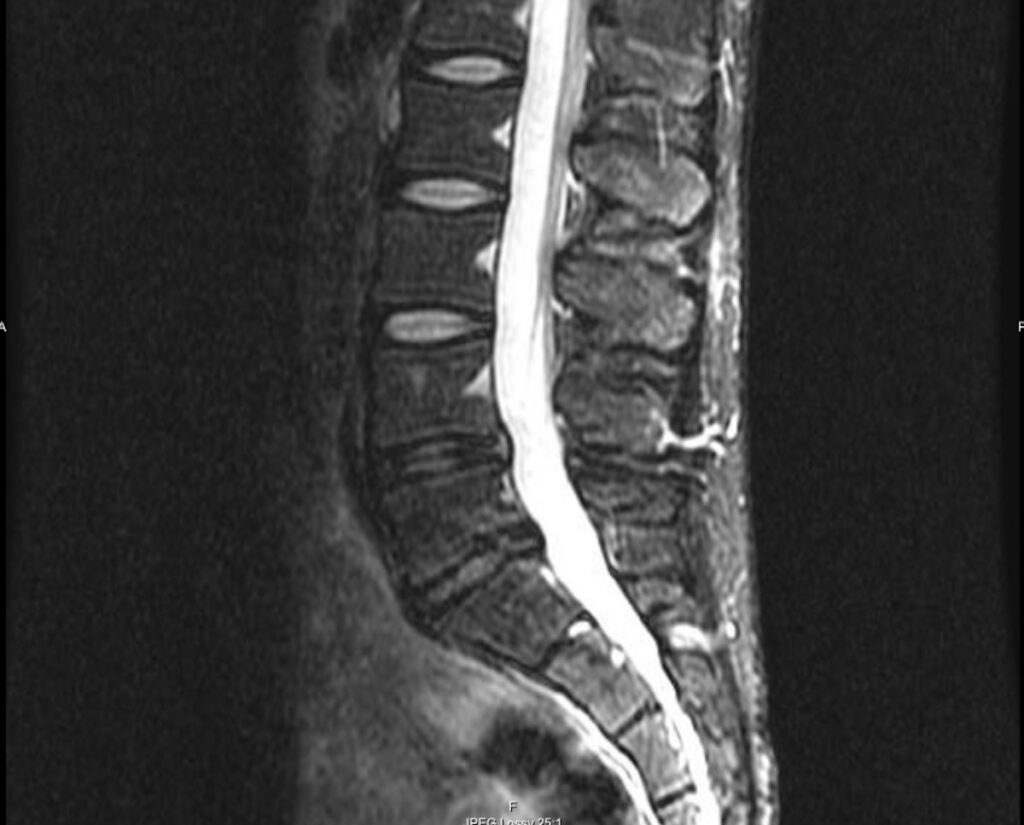
On MRI, this appears as disc desiccation (dark on T2 signal), disc height loss, and sometimes endplate irregularity or Modic changes in the adjacent vertebral bone. The degree of MRI finding doesn’t always match the degree of symptoms — many people with severely degenerated discs on imaging feel fine, while others with mild changes are significantly disabled. This discordance is important: it means the goal isn’t to reverse what shows on imaging, but to treat what’s causing your pain.
Why Surgery Isn’t Always the Answer
Spinal fusion for degenerative disc disease remains controversial. The procedure removes the diseased disc, inserts hardware, and permanently fuses two or more vertebrae together. For the right patient — severe structural instability, neurological deficit, or failed conservative care over years — it can provide meaningful relief. But the evidence is messier than most patients realize.
Multiple randomized controlled trials have found that spinal fusion for isolated disc degeneration without significant instability produces outcomes no better than structured rehabilitation at 2 and 5 years. Fusion also creates a biomechanical problem: when one level is locked, the adjacent segments bear increased stress, accelerating degeneration above and below the fusion. A systematic review pooled the incidence of this phenomenon — called adjacent segment disease — at approximately 26.6% after lumbar fusion [5].
Surgery doesn’t fix the biology. It eliminates the structure. For many patients with chronic discogenic low back pain, a non-surgical approach that addresses what’s happening inside the disc — and in the surrounding supporting structures — is a more appropriate first step.
The Role of the Functional Spinal Unit
Here’s what often gets missed in the standard workup: disc degeneration rarely occurs in isolation. The disc, facet joints, and spinal ligaments function as an integrated system — what regenerative medicine practitioners call the Functional Spinal Unit (FSU).
When the disc loses height and hydration, the segment becomes hypermobile. This throws excess stress onto the facet joints (causing facet arthritis) and onto the ligaments (causing laxity and instability). The ligaments — including the interspinous, supraspinous, and longitudinal ligaments — are supposed to be the passive stabilizers of the spine. When they weaken, the entire segment becomes a source of pain, not just the disc itself.
A case series published in Cureus applied the FSU framework to regenerative spine treatment, using PRP and prolotherapy targeted at the disc, facet joints, and ligamentous structures as a coordinated approach rather than treating one structure in isolation [1]. This is why effective regenerative care for DDD often involves more than a single intradiscal injection — it’s a treatment of the whole functional unit.
This is also why our approach at ProForm MD Sports & Spine begins with a comprehensive structural assessment, not just a review of what’s visible on MRI. For a broader overview of how regenerative medicine addresses the full range of spinal conditions, see our guide to regenerative medicine for back pain.
Intradiscal PRP: Delivering Healing Factors Where They’re Needed Most
Platelet-rich plasma (PRP) has a well-established role in regenerative medicine for joints and tendons. Its application to the intervertebral disc addresses a core problem: the disc’s poor blood supply means it lacks access to the circulating growth factors that drive healing elsewhere in the body.
Intradiscal PRP changes that equation. By injecting concentrated growth factors directly into the nucleus pulposus under fluoroscopic guidance, we deliver:
- TGF-β1 and IGF-1: stimulate disc cell (nucleus pulposus cell) proliferation and matrix production
- PDGF: promotes tissue regeneration and vascular support at the disc periphery
- Anti-inflammatory cytokines: modulate the chronic inflammatory environment driving discogenic pain
The clinical evidence is now substantial. A double-blind randomized controlled trial compared intradiscal PRP releasate directly to corticosteroid injection in patients with documented discogenic low back pain. At 60 weeks, the PRP group had an 87.5% responder rate compared to 40% in the corticosteroid group — and significantly superior disability scores at 26 weeks [2]. A separate clinical trial of intradiscal PRP injection confirmed meaningful pain reduction at 48 weeks post-injection, with significant improvements in both VAS pain scores and functional disability measures [4]. Unlike corticosteroids, PRP carries no risk of accelerating disc degeneration with repeated use.
At ProForm MD, we use the Regenexx protocol, which processes PRP to 14–20x your baseline platelet concentration — significantly higher than the 3–5x typical of standard bedside centrifuge kits, and above the 10-billion-platelet threshold associated with meaningful biological response in the research literature.
Intradiscal BMAC: When More Regenerative Signaling Is Needed
Bone marrow aspirate concentrate (BMAC) takes the regenerative approach further. Produced from an ultrasound-guided aspiration of bone marrow from the posterior iliac crest (hip), BMAC contains:
- Mesenchymal stem/stromal cells (MSCs) capable of differentiating into chondrocyte-like cells
- Concentrated growth factors including TGF-β, BMP-2, and VEGF
- Exosomes and extracellular vesicles that modulate the disc microenvironment
- A bone marrow-derived PRP fraction with a distinct cytokine profile
For patients with more advanced disc degeneration — significant height loss, Modic changes, or inadequate response to PRP — intradiscal BMAC provides a more robust biological signal. In a prospective one-year study of patients undergoing intradiscal BMAC injection, back pain scores fell from 5.4 to 3.0, leg pain from 2.8 to 1.3, and disability index improved from 33.5 to 21.1 — with 59.4% achieving clinically meaningful improvement [3].
The aspiration itself takes about 10–15 minutes under ultrasound guidance, using local anesthetic. The bone marrow is then processed in our on-site laboratory before being injected precisely under fluoroscopic guidance into the target disc(s).
| 📊 Clinical Highlight: In a prospective study of intradiscal BMAC injection for single-level discogenic low back pain, 59.4% of patients achieved clinically significant improvement in back pain at one year, with disability scores improving from 33.5 to 21.1 and quality of life scores rising from 0.69 to 0.78 [3]. |
Comparing Your Options for Degenerative Disc Disease
| Treatment | How It Works | Duration of Effect | Addresses Disc Biology? |
| Physical Therapy | Strengthens muscles, improves posture and load distribution | Variable; foundational | No — functional only |
| Epidural Steroid Injection | Reduces nerve root inflammation temporarily | Weeks to months; may accelerate disc degeneration with repeated use | No — anti-inflammatory only |
| Intradiscal PRP | Delivers concentrated growth factors into nucleus pulposus | 12+ months in responders; may slow degeneration progression | Yes — targets disc cell environment |
| Intradiscal BMAC | Delivers stem cells + growth factors + cytokines | 12+ months; suited to more advanced degeneration | Yes — most comprehensive regenerative signal |
| Spinal Fusion | Permanently immobilizes the painful segment | Variable; adjacent segment disease in ~26.6% after lumbar fusion [5] | No — eliminates the disc entirely |
What to Expect: The Treatment Process at ProForm MD
Every DDD patient begins with a thorough consultation: full history, physical exam, and detailed review of MRI imaging. We look at the severity and distribution of disc degeneration, the health of the facet joints at each level, whether ligamentous laxity or instability is contributing, and whether there is any nerve root involvement causing sciatica.
From there, treatment is individualized:
- For mild-to-moderate single-level discogenic pain: intradiscal PRP, often combined with facet joint PRP and/or ligament prolotherapy at the same session
- For moderate-to-severe or multi-level degeneration: intradiscal BMAC, with bone marrow-derived PRP directed at facet joints and ligaments
- For patients with radicular symptoms: epidural PRP at the affected nerve root level, in addition to disc-targeted treatment
All injections are performed with image guidance — fluoroscopy for intradiscal placement, ultrasound for the bone marrow aspiration — to ensure precise delivery. No IV sedation is used; procedures are performed under local anesthetic, with oral sedation available for patients who prefer it.
Post-procedure soreness for 2–5 days is normal and expected as part of the healing response. Most patients begin noticing meaningful improvement at 4–8 weeks, with continued progress through 3–6 months.
Frequently Asked Questions
Is “degenerative disc disease” really a disease?
Not in the traditional sense. It’s a descriptive term for age-related disc changes — similar to calling gray hair a “disease.” Most disc degeneration is part of normal aging. The goal is to determine whether degeneration is the actual driver of your pain, and if so, treat it appropriately.
My MRI shows bulging discs at multiple levels. Does that mean I need multiple injections?
Not necessarily. We perform careful clinical correlation — the symptomatic level(s) often don’t match every finding on MRI. Targeted treatment at the clinically relevant level(s) is usually more effective than treating every abnormality visible on imaging.
Can intradiscal PRP or BMAC actually regenerate a disc?
Complete structural regeneration — restoring a disc to its original height — is not a realistic expectation with current techniques. What the evidence supports is meaningful reduction in pain, improvement in function, and potentially slowing of progressive degeneration. For most patients, that’s a significant and durable outcome.
How does this compare to stem cell therapy I’ve seen advertised elsewhere?
Be cautious of clinics offering “stem cell therapy” from umbilical cord blood, amniotic fluid, or off-the-shelf products. The FDA has raised serious concerns about unproven products marketed this way. BMAC uses your own bone marrow — a regulated autologous procedure with a growing evidence base. This is the standard used in the Regenexx network.
Will I still need surgery if regenerative treatment doesn’t help?
Surgery remains an option if conservative and regenerative approaches don’t provide adequate relief. Trying regenerative treatment does not close the door to surgery. In our experience, however, many patients who come to us having been told they “need surgery” achieve sufficient relief to avoid it.
What is the cost, and does insurance cover this?
Intradiscal PRP and BMAC are not covered by insurance and are self-pay procedures. Detailed pricing is provided at consultation. We’re happy to discuss financing options.
How do I know if I’m a candidate?
The best way is a formal evaluation with Dr. Bonner, who will review your imaging, examine you, and give you a direct assessment of whether regenerative treatment is likely to help and which approach makes the most sense for your specific situation.
References
- Navani A, Helfet DL. Regenerative Injection Treatments Utilizing Platelet Products and Prolotherapy for Cervical Spine Pain: A Functional Spinal Unit Approach. 2021;13(9):e18337. PMID: 34660221
- Akeda K, Ohishi K, Takegami N, et al. Platelet-Rich Plasma Releasate versus Corticosteroid for the Treatment of Discogenic Low Back Pain: A Double-Blind Randomized Controlled Trial. J Clin Med. 2022;11(2):304. PMID: 35053999
- Haines CM, Bhatt FR, Orosz LD, et al. Low Back Pain, Disability, and Quality of Life One Year following Intradiscal Injection of Autologous Bone Marrow Aspirate Concentrate. Stem Cells Int. 2022;2022:9617511. DOI: 10.1155/2022/9617511
- Zhang J, Liu DY, Gong Q, Chen J, Wan L. Intradiscal Autologous Platelet-Rich Plasma Injection for Discogenic Low Back Pain: A Clinical Trial. Biomed Res Int. 2022;2022:9563693. PMID: 36262971
- Woiciechowsky C, Thomale UW, Callsen H, Beier N, Czabanka M, Finger T. Adjacent segment degeneration after fusion spinal surgery — a systematic review. Int Orthop. 2019;43(4):987–993. PMID: 30470865