
Can Bone Marrow Concentrate Stem Cells Help Knee Osteoarthritis?
Knee osteoarthritis is one of the most common reasons patients come to our clinic seeking alternatives to surgery. The condition involves a gradual breakdown of cartilage, inflammation within the joint, and — as we are learning more about — significant changes in the bone beneath the cartilage surface. For many patients, conventional treatments like physical therapy, anti-inflammatory medications, and cortisone injections provide only temporary relief.
This has led to growing interest in regenerative treatments, including bone marrow concentrate (BMAC) stem cell therapy. But what does the evidence actually show? And how is the way we deliver these treatments evolving? In this post, I’ll walk through what we know, what the research supports, and why the subchondral bone may be a critical part of the answer.
Understanding the Problem: Knee Osteoarthritis Is More Than Cartilage Loss
For decades, osteoarthritis was thought of primarily as a cartilage disease — the smooth surface wears away, bone rubs on bone, and pain results. While cartilage degeneration is certainly part of the picture, we now understand that knee osteoarthritis affects the entire joint, including the synovium (joint lining), the ligaments, and critically, the subchondral bone — the layer of bone directly beneath the cartilage surface.
Research has increasingly shown that changes in subchondral bone — including bone marrow lesions — play an important role in the progression of osteoarthritis and are closely associated with knee pain. A comprehensive review published in Frontiers in Cell and Developmental Biology (Zhu et al., 2021) described how abnormal subchondral bone remodeling, including increased bone resorption, altered bone architecture, and vascular invasion, contributes to cartilage breakdown and OA progression. The authors noted that targeting subchondral bone remodeling represents a promising therapeutic strategy for OA management.
This shift in understanding has important implications for how we treat knee osteoarthritis — and specifically, where we deliver regenerative treatments.
What Is Bone Marrow Concentrate Therapy?
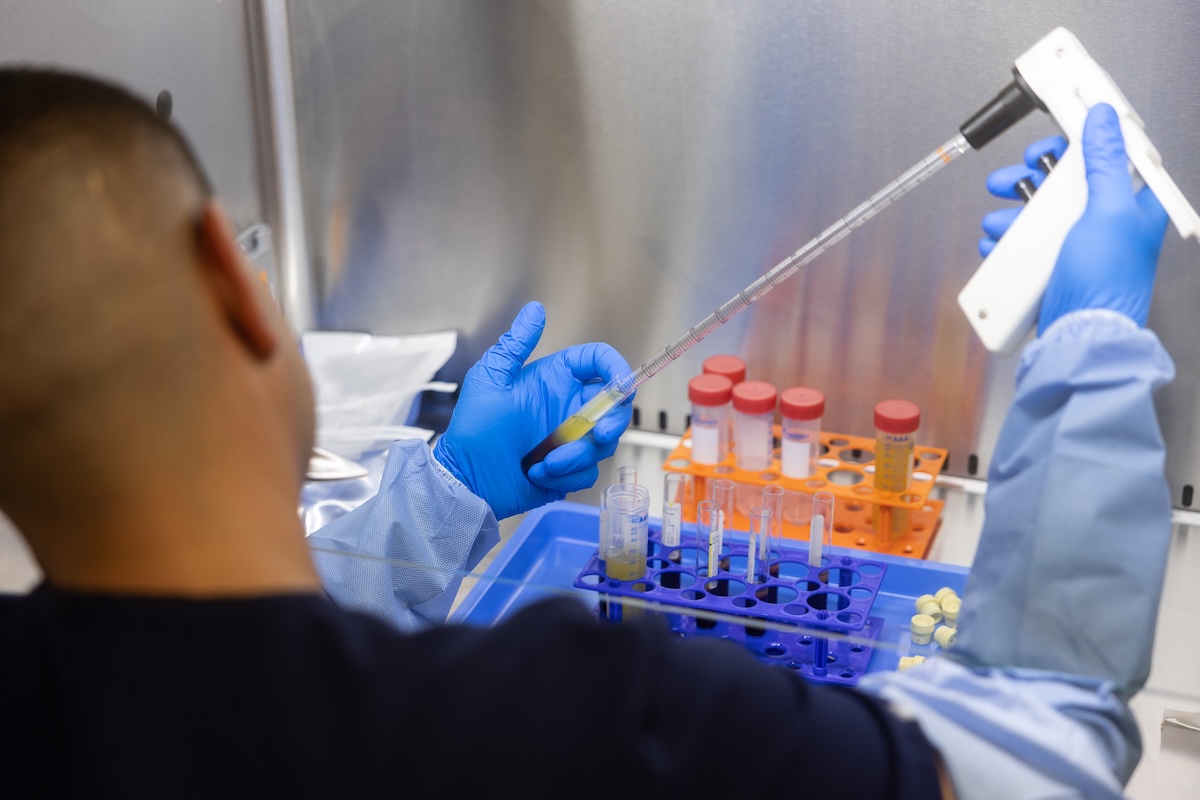
Bone marrow aspirate concentrate (BMAC) is a regenerative treatment in which a sample of bone marrow is collected from a patient’s pelvis, concentrated to increase the density of stem cells and growth factors, and then injected into the site of issue under image guidance.
The concentrate contains:
- Mesenchymal stem cells (MSCs) that can support tissue repair and regeneration
- Platelets and growth factors that reduce inflammation and promote healing
- Cytokines that help modulate the joint environment
Because the treatment uses your own biologic material, there is no risk of immune rejection. The entire procedure is performed in a single office visit under image guidance as part of the Regenexx network protocols.
What Does the Research Show? The Case for Subchondral Bone Injection
Traditionally, regenerative treatments for knee osteoarthritis have been delivered via intra-articular injection — meaning the cells are injected into the joint space. This approach targets the synovial fluid and cartilage surface. However, an important body of research suggests that delivering bone marrow concentrate directly into the subchondral bone may be significantly more effective.
Subchondral vs. Intra-Articular Injection: A 15-Year Comparison
In a landmark randomized controlled trial, Hernigou et al. (2021) studied 60 patients with bilateral knee osteoarthritis. Each patient received bone marrow concentrate in both knees during the same procedure — one knee received a subchondral bone injection and the other received a standard intra-articular injection. This design allowed a direct comparison of the two delivery methods in the same patient.
The results at 15-year follow-up were striking. Among the knees treated with subchondral injection, only 20% eventually required knee replacement, compared to 70% of the knees that received intra-articular injection. The annual rate of knee replacement was also significantly lower in the subchondral group. Clinical scores and MRI findings at two years were also better on the subchondral side.
Reference: Hernigou P, et al. Int Orthop. 2021;45(2):391-399. PMID: 32617651
Subchondral Stem Cell Therapy vs. Knee Replacement: A 15-Year Study
In a separate randomized study, Hernigou et al. (2021) enrolled 140 patients who were scheduled for bilateral total knee arthroplasty (TKA). Each patient received TKA on one knee and subchondral bone marrow concentrate injection on the other. At an average follow-up of 15 years, only 18% of the knees treated with subchondral stem cell therapy eventually required knee replacement — a rate comparable to the revision rate of the knees that received a primary TKA (15%).
The study also identified bone marrow lesions as a predictive factor: patients whose bone marrow lesions remained larger than 3 cm³ after treatment had a significantly higher risk of eventually needing surgery. This finding underscores the importance of addressing subchondral bone pathology in osteoarthritis treatment.
Reference: Hernigou P, et al. Int Orthop. 2021;45(2):365-373. PMID: 32322943
Why Does the Injection Location Matter?
The subchondral bone plays a much more active role in osteoarthritis than was previously understood. The review by Zhu et al. (2021) in Frontiers in Cell and Developmental Biology detailed how subchondral bone undergoes pathological remodeling throughout OA progression — including increased osteoclast activity, abnormal bone formation, development of bone marrow lesions and subchondral cysts, and invasion of blood vessels and nerves into areas that are normally protected.
When bone marrow concentrate is injected into the joint space alone, the stem cells and growth factors are delivered to the synovial fluid but may not adequately reach the subchondral bone where much of the pathology resides. Subchondral injection, by contrast, delivers cells directly to the site of bone marrow lesions and abnormal bone remodeling. This targeted approach may:
- Directly address the subchondral bone pathology driving cartilage breakdown
- Reduce the size and impact of bone marrow lesions
- Support healthier bone remodeling beneath the cartilage surface
- Provide a more durable treatment effect over time
The Hernigou studies demonstrated this with long-term data: subchondral delivery dramatically reduced the need for knee replacement compared to intra-articular delivery of the same cells in the same patient.
What Does This Mean for Patients With Knee Osteoarthritis?
If you’ve been told you have knee osteoarthritis and are looking for alternatives to knee replacement, the evolving research on bone marrow concentrate therapy is encouraging. A few important takeaways:
- Bone marrow concentrate stem cell therapy is a legitimate, evidence-based regenerative treatment — not the same as the unregulated “stem cell clinics” using products that don’t contain live cells
- Where the cells are delivered matters as much as the cells themselves. The subchondral bone is an increasingly recognized treatment target.
- Bone marrow lesions on MRI are an important finding that may influence both prognosis and treatment approach.
- Not every patient is a candidate. The best outcomes are seen in patients with mild to moderate disease, identifiable bone marrow lesions, and reasonable joint alignment,
- These treatments work best as part of a comprehensive plan that includes rehabilitation, activity modification, and sometimes complementary treatments like PRP therapy.
Our Approach at Our Miami Clinic
As a Regenexx network provider, Dr. Bonner has access to advanced processing techniques and image-guided delivery methods that allow for precise placement of bone marrow concentrate into both intra-articular and subchondral targets. Every procedure is performed under fluoroscopic and/or ultrasound guidance to ensure accuracy.
Our evaluation process includes a thorough review of your MRI to assess cartilage status, bone marrow lesions, joint alignment, and other factors that help determine whether BMAC therapy — and specifically, whether a subchondral approach — is appropriate for your condition.
If you want to learn more about our regenerative medicine program, or explore whether bone marrow concentrate therapy may be right for your knee, contact our clinic to schedule a consultation.
References
1. Hernigou P, Bouthors C, Bastard C, et al. Subchondral bone or intra-articular injection of bone marrow concentrate mesenchymal stem cells in bilateral knee osteoarthritis: what better postpone knee arthroplasty at fifteen years? A randomized study. Int Orthop. 2021;45(2):391-399. PubMed
2. Hernigou P, Delambre J, Quiennec S, Poignard A. Human bone marrow mesenchymal stem cell injection in subchondral lesions of knee osteoarthritis: a prospective randomized study versus contralateral arthroplasty at a mean fifteen year follow-up. Int Orthop. 2021;45(2):365-373. PubMed
3. Zhu X, Chan YT, Yung PSH, Tuan RS, Jiang Y. Subchondral Bone Remodeling: A Therapeutic Target for Osteoarthritis. Front Cell Dev Biol. 2021;8:607764. PMC Full Text
Disclaimer: This blog post is for educational purposes only and does not constitute medical advice. Results from regenerative treatments vary by individual, and not all patients are candidates. Please schedule a consultation to discuss your specific condition and treatment options.