
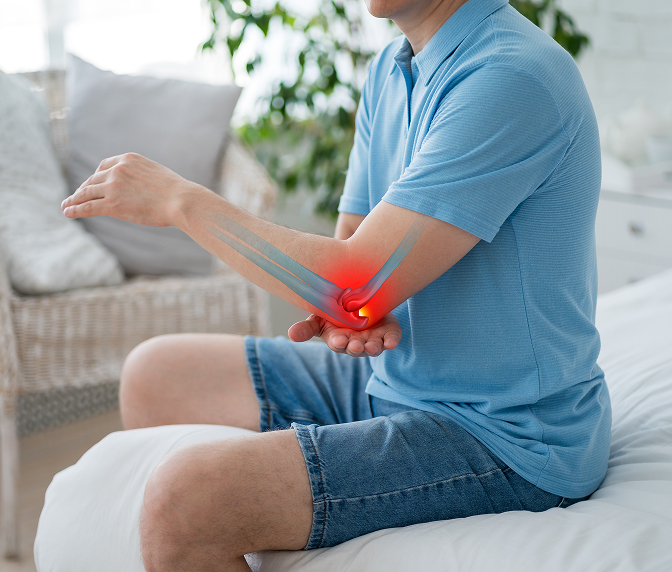
Elbow osteoarthritis is a degenerative joint condition that can cause pain, stiffness, and loss of motion in the elbow. Although less common than knee or hip osteoarthritis, elbow arthritis can significantly affect daily activities that involve gripping, lifting, or repetitive arm use.
At our Miami clinic, we provide a comprehensive, non-surgical approach to the evaluation and treatment of elbow osteoarthritis, focused on symptom relief, functional improvement, and individualized care planning.
Elbow osteoarthritis occurs when the cartilage that lines the elbow joint gradually wears down. This cartilage normally allows smooth, pain-free movement between the bones of the elbow joint.
As cartilage degeneration progresses, joint motion may become painful or restricted, and bony changes may contribute to stiffness or mechanical symptoms.
Symptoms may vary in severity and progression. Common symptoms include:
Symptoms often develop gradually over time.
Elbow osteoarthritis is less common than knee or hip OA because the elbow is a non-weight-bearing joint — but when it does develop, it can significantly limit overhead activity, lifting, and sports participation.
There are two distinct patterns of elbow OA with different clinical presentations and treatment implications:
Primary elbow osteoarthritis occurs predominantly in middle-aged men involved in heavy manual labor or high-demand overhead sports — particularly baseball, wrestling, and weightlifting. The dominant arm is most commonly affected. Primary elbow OA often involves the radiohumeral joint (between the radial head and capitellum) and produces characteristic loss of terminal extension and flexion with pain at end range.
Post-traumatic elbow osteoarthritis follows prior fractures, dislocations, or ligament injuries. It can affect any compartment of the elbow joint depending on the prior injury pattern and may develop years after the original trauma.
Understanding which type of elbow OA is present — and which compartments are affected — is important for determining the most appropriate treatment approach, including where to direct regenerative procedures.

Elbow osteoarthritis may develop due to:
Unlike other joints, elbow osteoarthritis is often associated with repetitive mechanical stress rather than age alone. Elbow OA can coexist with elbow epicondylitis — both conditions should be assessed when evaluating chronic elbow pain.
Diagnosis involves correlating symptoms with physical examination findings and imaging results. Evaluation typically includes:
Detailed history and activity assessment
Physical examination of elbow motion and strength
Review of prior imaging
X-rays to evaluate joint space narrowing and arthritic changes
MRI in select cases to assess surrounding soft tissues
Imaging findings are interpreted in the context of symptoms, as degenerative changes do not always cause pain.
A multifaceted, conservative approach to elbow osteoarthritis can significantly improve outcomes without surgery.

Physical therapy may focus on:
Therapy programs are tailored to avoid symptom exacerbation.
Treatment strategies may include:
These measures help reduce joint irritation.
Medication may be used to relieve symptoms:
Medication is used thoughtfully as part of a broader plan.
In select cases, image-guided injections may be considered:
Procedures are performed using ultrasound guidance to improve accuracy and safety

For patients with elbow osteoarthritis who have not achieved adequate relief from physical therapy and standard injections, regenerative medicine offers a biologically targeted option for modifying the joint environment and supporting cartilage health.
PRP concentrates growth factors from your own blood and delivers them into the elbow joint under ultrasound guidance. These growth factors reduce chronic synovial inflammation, support cartilage cell survival, and modify the joint environment in ways that cortisone cannot achieve. PRP is most appropriate for mild to moderate elbow OA and is typically the first regenerative option considered.
For patients with more advanced elbow OA — particularly those with significant cartilage loss or when PRP has not provided sufficient improvement — BMAC adds mesenchymal stem cells to the growth factor payload, providing a more potent regenerative stimulus for the arthritic joint.
All elbow regenerative procedures are performed under ultrasound guidance with confirmation of accurate intraarticular placement. As a credentialed Regenexx network provider, Dr. Bonner follows evidence-based protocols for all regenerative procedures.
| Treatment Type | Purpose | Duration of Impact | Invasiveness |
|---|---|---|---|
| Physical Therapy | Improve movement and function | Long-term with adherence | Non-invasive |
| Medications | Pain and inflammation control | Short-term | Non-invasive |
| Bracing/Support | Reduce joint stress | Activity-dependent | Non-invasive |
| Injections (steroid, hyaluronic acid) | Reduce inflammation | Weeks to months | Minimally invasive |
| Regenerative Treatments (PRP/BMAC) | Promote healing | Potential long-term | Minimally invasive |
| Surgery (if necessary) | Structural repair | Permanent | Invasive |
Many patients benefit from a coordinated, non-surgical plan before considering surgical intervention.
You may be a good candidate if you:
Treatment plans are individualized.

Active adults and professionals often place significant stress on the elbows through sports and repetitive movements. Treatment focuses on:
The goal is to help patients remain active and productive while managing symptoms safely and effectively.
Rarely. Many cases of elbow osteoarthritis can be treated successfully with non-surgical care including therapy, patience, injections, and regenerative procedures.
When performed by trained specialists using your own biologic materials, regenerative procedures are generally considered safe and may support healing processes. These procedures should always be performed with imaging guidance like ultrasound and fluoroscopy to target very specific structures in or around the elbow joint.
Recovery times vary by condition and treatment. Rehabilitation and regenerative care may take weeks to months for optimal improvement.
Imaging is used when it will meaningfully influence diagnosis or treatment planning. It is often used to assess the severity of arthritis and guide treatment planning. In cases of elbow osteoarthritis, the pain pattern can often overlap those related the shoulder or pinched nerves in the neck, so imaging studies can be useful to help differentiate the etiology of pain.
Elbow OA is less common than knee or hip OA because the elbow is a non-weight-bearing joint. It occurs most frequently in men involved in heavy manual labor or overhead sports, and in patients with prior elbow injuries. When it does develop, it can be significantly limiting — particularly for active adults and athletes who rely heavily on elbow function.
PRP can reduce synovial inflammation and support cartilage health in elbow osteoarthritis by delivering concentrated growth factors directly into the joint under ultrasound guidance. It is most effective for mild to moderate disease. Dr. Bonner will review your imaging and examination findings to determine whether PRP is appropriate for your stage of elbow OA.
If you are experiencing elbow pain, or another painful condition, and want a comprehensive evaluation and non-surgical treatment plan, we are here to help. Contact our Miami clinic to schedule an appointment.
CONTACT US