
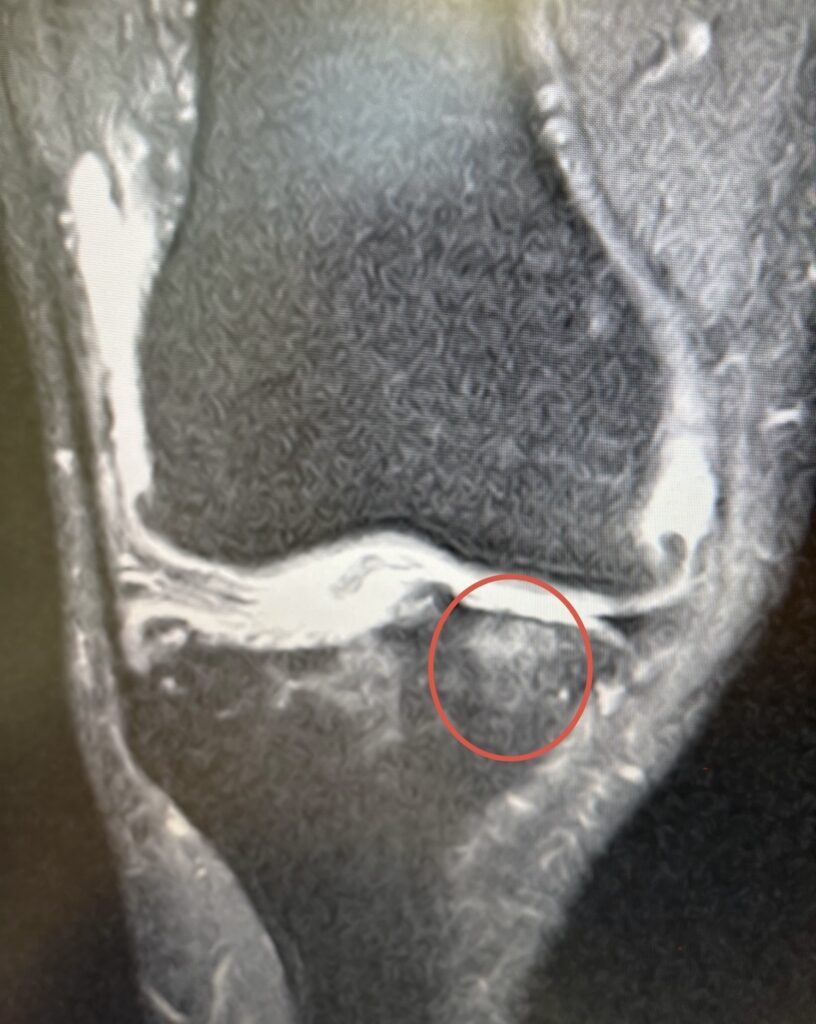
If you’ve had an MRI for knee pain, your report may mention ‘bone marrow edema,’ ‘subchondral signal change,’ or ‘bone marrow lesions.’ These terms often appear almost as afterthoughts — mentioned briefly, rarely explained, and almost never specifically treated. Yet research has established that bone marrow lesions (BMLs) are the single strongest MRI predictor of pain intensity in knee osteoarthritis. They are also one of the most important predictors of how quickly your knee will get worse over time.
The fact that BMLs are so frequently overlooked in clinical practice is one of the most significant gaps between what the research shows and what patients actually receive.
What Are Bone Marrow Lesions?
Bone marrow lesions represent areas of microdamage, trabecular bone stress, edema, and cellular changes within the subchondral bone — the dense bone layer just beneath the articular cartilage. They show up on MRI as areas of abnormal bright signal on fluid-sensitive sequences.
They are not simply ‘bone bruises’ from trauma. In the context of knee osteoarthritis, BMLs reflect chronic mechanical overload and the biological breakdown that occurs at the osteochondral interface — the zone where bone meets cartilage. They are a sign that the structural stress on the knee is exceeding what the tissue can manage, and they are actively contributing to both pain and disease progression.
Why Bone Marrow Lesions Matter — The Research
- BMLs are the strongest MRI predictor of pain in knee osteoarthritis — stronger than cartilage loss, osteophytes, or synovitis
- Larger BMLs predict faster cartilage loss over time
- Persistent BMLs after treatment are a strong independent risk factor for eventual total knee replacement
- In Hernigou et al.’s 15-year randomized trial, persistent BMLs larger than 3 cm³ after cell therapy carried a hazard ratio of 4.42 for subsequent TKA — regardless of OA grade (PMID: 32322943)
That last finding is particularly important. Even when OA grade is controlled for, the behavior of bone marrow lesions after treatment is one of the strongest predictors of whether a knee will need replacement. BMLs are not incidental findings. They are a central part of the disease.
Why Standard Treatments Don’t Address Bone Marrow Lesions
Cortisone injections suppress inflammation in the joint space. Cortisone does not penetrate subchondral bone in clinically meaningful concentrations. It does not reach the BML.
Hyaluronic acid lubricates the joint. It does not reach the subchondral bone.
Standard intraarticular PRP and BMAC injections deliver growth factors and cells into the joint space — which modifies the intraarticular environment but does not directly address the bone marrow pathology.
This is why patients with significant BMLs often have incomplete responses to these treatments, and why a different approach — one that directly targets the bone — may produce better results.
How BMAC Targets Bone Marrow Lesions
Because BMAC is derived from bone marrow itself, it is biologically native to the environment where BMLs occur. When delivered intraosseously — directly into the subchondral bone lesion under fluoroscopic guidance — BMAC provides:
- Mesenchymal stem cells that can differentiate into osteoblasts and support subchondral bone repair
- Anti-inflammatory cytokines that address the chronic bone marrow inflammation driving the lesion
- Growth factors including BMP-2 and TGF-β that support bone matrix remodeling
The Hernigou research demonstrated that this approach produces BML regression over 24 months and meaningfully reduces the long-term risk of knee replacement. This is the only treatment approach with evidence for actually addressing the BML rather than simply managing symptoms around it.
For more detail on this procedure, see our page on BMAC for bone marrow lesions.
How Do I Know If I Have Bone Marrow Lesions?
BMLs are only visible on MRI — they do not show up on X-ray. If you’ve had an MRI of your knee, look at the report for phrases like:
- ‘Bone marrow edema’
- ‘Subchondral signal change’
- ‘Bone marrow lesion’
- ‘Subchondral edema pattern’
If any of these are mentioned and have not been specifically addressed in your treatment plan, bring your MRI to a consultation so we can review it directly. The size, location, and extent of BMLs all affect how we approach treatment. Learn more about bone marrow lesion treatment options.
Frequently Asked Questions
Can bone marrow lesions heal on their own?
Some BMLs from acute trauma resolve with rest. BMLs associated with chronic OA tend to persist and worsen over time without targeted treatment — and their persistence predicts faster disease progression.
My doctor didn’t mention my bone marrow lesions — should I be concerned?
It depends on the clinical context, but it’s worth raising. BMLs are frequently noted in MRI reports without being discussed specifically in the treatment plan — partly because most conventional treatments don’t directly address them. If you have significant BMLs and are still experiencing significant pain, targeted treatment may be an option worth discussing.
Are bone marrow lesions always in the knee?
No. BMLs can occur in any joint — hip, shoulder, ankle, spine (where they are called Modic changes). They are most extensively studied in the knee, but the same principles of subchondral bone pathology apply to other joints.
If you’re dealing with knee pain and bone marrow lesions and want to understand your treatment options and want to explore whether regenerative medicine is right for you, schedule a consultation at our Miami clinic. You can also book online through ZocDoc. We’ll review your imaging, your history, and your goals and put together a plan that makes sense for your specific situation.
Learn more: BMAC stem cell therapy | PRP therapy | Regenerative medicine in Miami | Regenexx provider Miami
References
- Hernigou P, Delambre J, Quiennec S, Poignard A. Human bone marrow mesenchymal stem cell injection in subchondral lesions of knee osteoarthritis: a prospective randomized study versus contralateral arthroplasty at a mean fifteen year follow-up. Int Orthop. 2021;45(2):365-373. PMID: 32322943.
- Driban JB, et al. Evaluation of bone marrow lesion volume as a knee osteoarthritis biomarker: longitudinal relationships with pain and structural changes. Arthritis Res Ther. 2013;15(5):R112. PMID: 24020939.
Disclaimer: This post is for educational purposes only and does not constitute medical advice. Results from regenerative treatments vary by individual, and not all patients are candidates. Please schedule a consultation to discuss your specific condition and treatment options.